Sharks and the Illusion of Separation

By Katie Sheahan | May 26, 2026
My first encounter with sharks was as a young child visiting my parents’ previous home of San Diego. As soon as we would arrive, we’d race to La Jolla Cove and throw on our snorkels. Here, we drifted above hundreds of harmless leopard sharks, where they gather annually in masses in the shallow, warm waters from June through December. My sister and I weren’t fearful watching these bottom-feeders coast along the sand, but we also didn’t know they were sharks. As soon as our parents told us what they were, we were already back on shore. Why did learning they were sharks make us become so fearful? I hadn’t encountered other sharks in the ocean before, and I didn’t know anyone who’d been bitten. I also hadn’t seen Jaws, the film renowned for villainizing sharks, whose crew then worked effortlessly to change the narrative about these apex predators. But the media loves to hate sharks. We see it in kids cartoons, like bloodthirsty Bruce, the great white shark from Finding Nemo. Even more recent movies like Sharknado and The Meg reinforced the idea that sharks are mindless predators. We’ve all been subtly taught to not just fear sharks, but to hate them.

When I began SCUBA diving, I was shocked by what I discovered in the coral reefs of the Caribbean and Florida. I was in the US Virgin Islands for my certification dive, and I encountered reef sharks for the first time. Underwater, scuba instructors/guides will often bang a little piece of metal on their tank to get their group’s attention if they spot a cool creature. So when I heard the faint metallic ding, and turned around to see a shark gliding right by us, I looked at my guide’s face. I expected to see fear, or that she’d called the groups’ attention to prepare for danger. But all I saw was awe and amazement. Someone who makes a living off being underwater, on knowing how to be prepared in the face of real danger, was still amazed by these gentle apex predators. Since then, I’ve swam with countless sharks across so many different species, and while the baby black tip reef sharks are curious and mouthy like puppies, I’ve only ever been a witness to their sheer strength and beauty, even while sharing their waters.
Sharks are curious, intelligent, and fully capable of suffering the same injuries and illnesses we do, while feeling every moment of it. After dozens of dives with reef sharks, there was a moment during field research with Ocean First Institute that I finally felt I understood the creatures I’d been sharing the water with. While studying the bioaccumulation of heavy metals in coastal sharks, I was in the water photographing a nurse shark while the research team was taking blood samples. As soon as this shark surfaced, we noticed something strange. A white mesh bag with a giant fishing hook was attached to the shark through its mouth. A chum bag. We quickly checked coordinates and took measurements, and the scientists discovered something amazing. One month earlier, we had tagged and sampled the same shark. However, it must not have been long after that outing that the shark ate a chum bag left in the reef by the fishing community. The male was the same length, but had lost considerable circumference due to its inability to eat with the hook in its mouth. It moved very little over the course of the next month, conserving energy as much as he could, until we caught him again. While documenting the removal of the bag and hook, I treaded in the water, eye to eye with this creature. The nurse shark’s eyes, naturally red and black, were full of fear, yet it did not move an inch. I can still see it looking back at me, motionless in the water, as if it understood what was happening. There was something like a flash of relief when the hook came out, and I snapped a few last photos before climbing back into the boat. We released the shark back into the open water, where he could now eat his fill of reef fishes, and I’m excitedly awaiting a publication someday that may reveal more clues about the impacts human actions have on sharks.

This experience was not just a moment of connection. It was a full glimpse into what might happen if the apex predators of the ocean were to disappear. Apex predators of any ecosystem play a crucial role in controlling prey populations and acting as an indicator of environmental health. When the top species of a food chain is affected, that effect cascades down and if thorough enough, can topple an entire ecosystem of organisms. Sharks are the enforcers of natural selection, eating ill or injured fish, keeping abundant species in control, and allowing a stronger, healthier reef community to thrive. They stabilize the ocean food web and ultimately prevent it from collapsing. As scientists, we know that a shark sighting is a beacon for biodiversity.

As the public, this isn’t always as clear. A declining shark population may seem like it’s in humans’ best interests. But here’s what it really means. Anthropomorphic pressures like climate change (Santos et al. 2024) and overfishing (Calbet et al. 2025, Dulvy et al. 2021) are driving sharks and rays dangerously towards extinction, which will begin to have visible effects on the ocean and other ecosystems. For example, when tiger sharks are present in a seagrass ecosystem, herbivores like sea turtles move around more and do not overgraze one area. However, without these apex predators, seagrass beds may be damaged or depleting from overgrazing. Even humans depend on sea grasses In Australia, studies show that reefs with more sharks, like Rowley Shoals, have greater biodiversity and healthier ecosystems than shark-depleted areas like Scott Reef. Without top predators, there can be increases in mid-level predators, which may reduce populations of fish that humans rely on. These changes can impact fisheries, species richness, and ecosystem services. In its full effect, when shark and ray populations collapse, the ocean becomes less resilient to climate change, pollution, and other stressors. This is all to say: unhealthy (i.e decreasing) shark populations = an unhealthy ocean = an unhealthy planet.
Now that I’ve overloaded you with facts about why sharks are necessary to global health, I want to talk about why, intrinsically, sharks are worth saving. Even if they didn’t ensure healthy oceanic food chains that humans depend on, these creatures have evolved and outlasted every geological catastrophe imaginable. Sharks have existed in Earth’s oceans for about 450 million years (Abel & Grubbs 2023, Litman 1996). For perspective, trees appeared roughly 400 million years ago, and flowering plants evolved around 250–140 million years ago (Thomas 2014). Sharks have been on Earth longer than it takes our Solar System to complete one orbit around the center of the Milky Way galaxy (~225 million years). They are also more than 200 million years older than the earliest known dinosaurs and have survived all five major mass extinction events, including the one that wiped out the non-avian dinosaurs. Sharks even predate the Atlantic Ocean itself, which began forming around 180 million years ago.
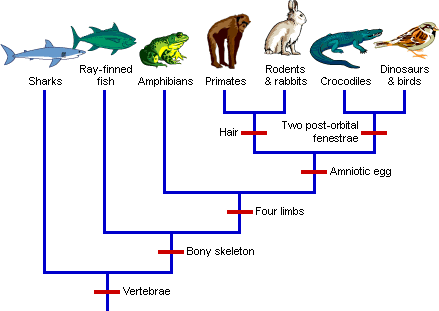
Sharks are also just genuinely wild from a biological design standpoint. They have
specialized electroreceptors called ampullae of Lorenzini that can detect the faint electrical fields produced by muscle contractions and heartbeats of prey, essentially letting them “sense” life hiding in sand or murky water. Their skin is covered in tiny tooth-like structures called dermal denticles, which reduce drag and turbulence so efficiently that engineers study them to design faster, more energy-efficient swimsuits, ships, and even aircraft surfaces. Many species can continuously replace thousands of teeth over their lifetime, with some losing and regrowing an entire set in just weeks, and their skeletons are made entirely of cartilage rather than bone, making them lighter, more flexible, and incredibly well-adapted for stealth and speed. Some sharks can even regulate buoyancy without a swim bladder by using a large, oil-filled liver, and certain species can migrate across entire ocean basins, tracking subtle changes in temperature, currents, and prey availability with astonishing precision.

All of these adaptations point to something easy to forget when we think about wildlife: sharks are not fragile or accidental survivors, but finely tuned products of deep time, built for a planet that is constantly in motion. And that motion connects places that feel, on the surface, completely separate.
As disconnected as Colorado may feel from these ocean giants, it is not separate from them. Every river, runoff event, snowmelt cycle, and atmospheric shift eventually feeds into downstream systems that shape coastal and open-ocean ecosystems. Pollution, nutrient loading, and climate-driven changes in water temperature and circulation do not stop at mountain watersheds; they accumulate and propagate all the way to the sea. In that sense, distance is an illusion in ecology. The health of sharks is tied, however indirectly, to decisions made far inland. Recognizing that interconnectedness is the point: responsibility does not diminish with geography, and protecting ocean life is inseparable from how we steward the land and water systems that ultimately flow into it.

Abel, D. C., & Grubbs, R. D. (2023). The lives of sharks: a natural history of shark life.
Calbet, A. (2025). The Overexploitation of Sharks. In The Ocean of Today, the Legacy of Tomorrow: Navigating the Future of Marine Life and Ecosystems
(pp. 125-130). Cham: Springer Nature Switzerland.
Dulvy, N. K., Pacoureau, N., Rigby, C. L., Pollom, R. A., Jabado, R. W., Ebert, D. A. & Simpfendorfer, C. A. (2021). Overfishing drives over one-third of all sharks and rays toward a global extinction crisis. Current Biology, 31(21), 4773-4787.
Litman, G. W. (1996). Sharks and the origins of vertebrate immunity. Scientific American, 275(5), 67-71.
Santos, C. P., Rosa, R., & Frazão-Santos, C. (2024). Global risk assessment of sharks to climate change. Science of The Total Environment, 954, 176361.
Thomas, P. A. (2014). Trees: their natural history. Cambridge University Press.


Comments